
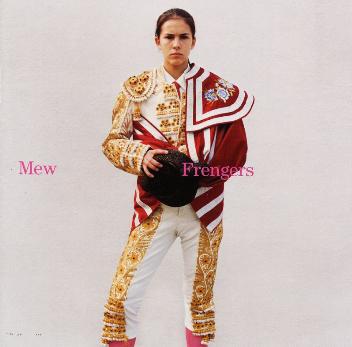
The normal process here at YSR is to listen to the record first, before looking at any information on the artist (when I haven’t heard of them previously, as in this case). The point of that is to get a clean feel for the work before having it get colored by suppositions and inferences made from the artist’s story and/or intentions. I like to take from the music directly where possible and do my research on the back side.
My perception of Mew got a little disjointed when I started looking at their bio. I’ve been listening to Frengers all week, planning out comparisons and looking at bands they remind me of; in particular, their vocals make me think of Emily Haines from Metric– sweet in a girlish way, like Tanya Donelly on the first Belly record. Except in Mew’s case, that voice belongs to a (then) 27 year old man and not a 19 year old woman.
So yeah, discovering Jonas Bjerre’s unusually high voice threw me for a minute. Not to get trapped in gender perceptions or heteronormativity or any of the perils involved with them, but I process songs with a perspective that includes the singer’s gender and sexuality. Flipping Frengers from a female to a male perspective took me a couple of moments; it’s a very high mark in Mew’s favor that the record works from both points of view.
With that being said, let’s talk about the record. Frengers is Mew’s first major-label, having put out a couple of indies in their native Denmark first (six of the ten tracks here are re-recordings of songs from those records). The band’s sound is both light and dense at the same time; chimey synths color under Bjerre’s voice like autumn sunshine while the bass, drums, and guitar make complex interplays behind them. Musically, Mew are very technically proficient; there are some complicated polyrhythms on Frengers, where each instrument is operating on a different rhythmic pace with the whole coming together into an even richer pattern (they occasionally make me think of what the Police might have been if they were 30 years younger). The layering here gets deep. Taken as a whole, the sound could get very prog but instead their tonality – mixed with the ethereal voice – puts Mew fairly in the center of indie, comparing well against The Naked and Famous, for example (but much, much more musical), or a less bombastic Muse.
Frengers is at its best when those dense layers are at their thickest; “Snow Brigade” in particular has a depth of sound and a sense of urgency that makes it easily the record’s best song. “Am I Wry? No” and “Shespider” follow to a lesser extent, but making use of transitions between softer segments and more aggressive ones to make larger-scale rhythmic variance. Mew are less interesting when they slow down. “She Came Home For Christmas” makes up for a bit of dullness in its music with a strong and subtle lyrical treatment about surviving abuse, and “Her Voice is Beyond Her Years” is simply pretty as fuck, but the two other downtempo tracks – “Symmetry” and the closer “Comforting Sounds” – are snoozers. It especially bothers me with the final track; Hot Fuss is crippled the same way, even Favourite Worst Nightmare (one of my personal favourite records) falls victim. A closing track should be one of the most memorable of the album – think “A Day in the Life“.
I’ll admit that I have one peculiar, stupid, nit-picky complaint about Frengers: there are a few places, most noticeably in the closing segment of “Am I Wry? No”, where the guitarist’s string squeak is so loud in the mix that it drives me nuts. Does it agitate me? Absolutely. Is it a reason to dislike the record? Absolutely not.
Final Grade: B+. The chops are there. The good songs are GREAT. But the weak, unsatisfying bits are obvious and closing with the flattest song on the record is a full demerit. Get the album, but focus on “Snow Brigade”, “Shespider”, and “Her Voice is Beyond Her Years”; add “She Came Home For Christmas” if you’re a lyric junkie.
 Your Shitty Record Won't Review Itself